Textile dyeing is a critical stage in fabric manufacturing that determines color quality, uniformity, fastness, and overall product value. A well-controlled dyeing process relies not only on dyes but also on dyeing auxiliaries, which play an essential role in improving efficiency, consistency, and reproducibility.
This guide outlines the standard textile dyeing process and provides practical recommendations for key dyeing auxiliaries.
While specific procedures vary depending on fiber type and dye class, the general dyeing workflow includes the following steps:
Textile Dyeing Process
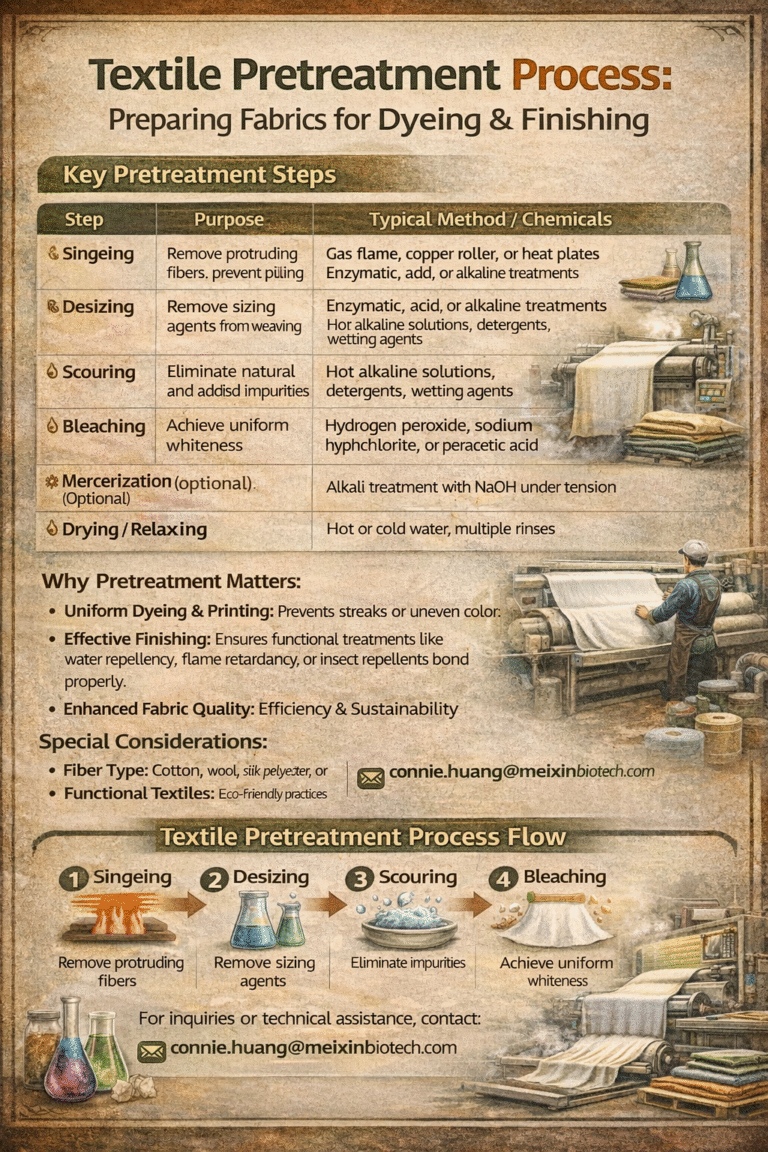
1. Pretreatment
Purpose:
- Remove natural and added impurities
- Improve fabric wettability and dye affinity
Typical processes include singeing, desizing, scouring, and bleaching. Proper pretreatment is the foundation of even dyeing and good color fastness.
2. Dyeing
Purpose:
- Allow dyes to penetrate and bond with fibers
The dyeing stage depends on:
- Fiber type (cotton, polyester, wool, nylon, blends)
- Dye class (reactive, disperse, acid, vat, direct)
- Process conditions (pH, temperature, time, liquor ratio)
3. Fixation
Purpose:
- Improve dye–fiber bonding
- Enhance color strength and fastness
Fixation may involve alkali addition, temperature control, or chemical fixing agents.
4. Washing & Soaping
Purpose:
- Remove unfixed dyes and residual chemicals
- Improve color fastness and fabric cleanliness
5. Finishing
Purpose:
- Improve hand feel, appearance, and functionality
- Prepare fabric for further treatments (softening, functional finishing)
Key Dyeing Auxiliaries & Recommendations
| Dyeing Auxiliary | Function | Recommendation |
|---|---|---|
| Wetting Agent | Improves fabric wet-out and dye penetration | Choose low-foam, fast-penetrating types for uniform dyeing |
| Sequestering Agent | Binds metal ions (Ca²⁺, Mg²⁺, Fe³⁺) | Essential for hard water and reactive dyeing |
| Leveling Agent | Promotes even dye distribution | Use fiber- and dye-specific leveling agents |
| Dispersing Agent | Prevents dye agglomeration | Critical for disperse dyeing of polyester |
| Alkali Agent | Activates dye–fiber reaction | Control dosage carefully to avoid uneven shades |
| Fixing Agent | Improves wet fastness | Recommended for deep shades and dark colors |
| Soaping Agent | Removes unfixed dye | Use high-efficiency, low-foaming soaping agents |
| pH Buffer | Stabilizes dye bath pH | Improves shade reproducibility |
| Anti-foaming Agent | Controls foam during processing | Select silicone or non-silicone based on system |
Dyeing Recommendations by Fiber Type
| Fiber Type | Typical Dye Class | Key Dyeing Considerations | Recommended Auxiliaries |
|---|---|---|---|
| Cotton | Reactive dyes | Requires thorough pretreatment; sensitive to metal ions; alkali control is critical | Sequestering agents, wetting agents, leveling agents, alkali agents, high-efficiency soaping agents |
| Polyester | Disperse dyes | High-temperature dyeing (≈130°C); risk of dye agglomeration | Dispersing agents, leveling agents, anti-foaming agents, reduction clearing agents |
| Wool | Acid dyes | pH-sensitive fiber; gentle processing required to avoid damage | Mild leveling agents, pH buffers, fiber-protective auxiliaries |
| Nylon | Acid / Metal-complex dyes | Rapid dye uptake; risk of unlevel dyeing | Leveling agents, pH regulators, fixing agents |
| Blended Fabrics | Mixed dye systems | Compatibility between fibers and dyes is essential; often requires stepwise dyeing | Multi-functional leveling agents, sequestering agents, compatible dispersing agents |
Conclusion
Effective textile dyeing relies on a well-controlled process and the careful selection of dyeing auxiliaries tailored to each fiber type. From pretreatment and dyeing to fixation and soaping, the right auxiliaries help ensure color uniformity, fastness, and reproducibility while improving overall processing efficiency.
Founded in 2005 in Zhongshan, Guangdong, Meixin Biotech brings over 20 years of experience in textile auxiliaries, supporting dyeing and finishing processes across cotton, polyester, wool, nylon, and blended fabrics. With strong R&D capabilities and a focus on performance and sustainability, Meixin works closely with textile manufacturers to deliver reliable, customized chemical solutions.
For technical inquiries or collaboration opportunities, please contact connie.huang@meixinbiotech.com.